
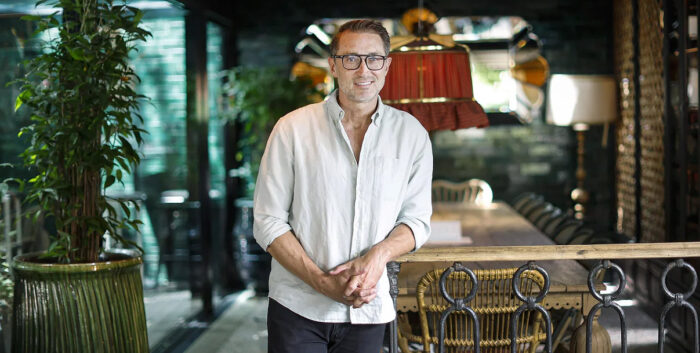
A pizzaiolo we ought to be paying attention to.
Greg Yurkovich is too little known, considering that food is made under his direction in no fewer than four venues in the very centre of Ljubljana. And there is something else: on the list of The Best Pizza Chef, which ranks the finest international masters, he was recently placed among those on the rise who deserve special attention.
And not only the Best Pizza Chef award. Late June brought other good news as well: Pop’s Pizza Place, where they bake to Yurkovich’s recipe and under his supervision, took 34th place among the best European pizzerias in the selection made by 50 Top Pizza, which produces detailed rankings for all the major regions of the world, and for Italy in particular. This agreeable pizzeria on the embankment of the Ljubljanica, with its eclectic yet homely interior, and holding certification as a true Neapolitan pizzeria, is therefore one more of the otherwise rare hospitality addresses in Slovenia that draw attention to the scene here through their presence on international lists. Who would have thought that not long ago Greg Yurkovich had no idea about pizza.
The American Slovene Yurkovich is not in fact a professional cook or pizzaiolo at all. He found himself in this trade through a series of coincidences, and he stayed because of a trait of character: he evidently does not shy away from a challenge, or from learning. By education he is a political scientist, and he worked in finance. Before returning from California to the homeland of his parents, he was involved in private equity investment. He never once thought that he would one day be grilling burgers, breaking down tuna, and appearing on stage with some of the best pizza masters, as happened at the end of June in Milan. In his own way he is another in the line of Slovenian chefs who came from entirely different industries, leapt over the obstacle of a deficient culinary education, and — probably also thanks to the ability to look at this business from a completely different perspective — hoisted themselves to the top. The two best in the field of fine dining, Ana Roš and David Žefran, are the same.So what chain of events brought a financier to the point of being food director in a cluster of three Ljubljana venues that share the name Pop’s, and Gostilna As besides? In first place one has to put an acquaintance from his younger days, when the Yurkovich family came to Slovenia only for holidays and visits — and always stopped in Dutovlje. There stood one of those legendary inns, conceived by a former customs officer, Svetozar Raspopović – Pope. This fiery and unusual host made an impression on every guest, and always did: something through his showmanship, and still more through his commitment to consistently using the best and freshest ingredients. One consequence of the frequent visits was that a friendship sprang up between Yurkovich and Sebastijan Raspopović, the son of the house, he recounts. Let us wind the clock forward. In the meantime Yurkovich had grown tired of the United States and moved — temporarily, everyone thought at first — with his family, his wife, the singer Hannah Mancini, and their daughter, to Ljubljana. The family fitted nicely into the life of the city. And so one day Lior Kochavy (Odprta kuhna) offered him the chance to judge burgers on a special day at the market — because he was, after all, an American, and would presumably know about it. Yurkovich said he would rather compete instead. Since he needed a hospitality operation behind him, he went to Raspopović junior. It worked out. In 2015 the two became partners and started their first joint project, Pop’s Place, known for its burgers. The next, four years later, was devoted to pizza; then came Aperitivo in Knafljev prehod, and Yurkovich also took over the thinking about food at Gostilna As, which is again an entirely different scheme, one leaning more towards the principles of fine dining. Their partnership rests on Raspopović being responsible for everything connected with organisation, and Yurkovich for the food. The circle that began in an inn on the Karst was closed in the same inn, except that this one has now been in Ljubljana for a long time.
How such a leap — from finance to pizza and burgers — is even technically possible is best described by Yurkovich’s anecdotes about how he trained as a pizzaiolo. When he and Raspopović agreed that pizza would make a fine new challenge after burgers, he knew nothing about it. “Zero point zero,” says Yurkovich precisely, a man of numbers. He gamely enrolled in a beginners’ course — where else but in Naples, at the school called Associazione Verace Pizza Napoletana, AVPN. It began wretchedly, he says. “I arrive in Naples, and there’s chaos. I could barely find the apartment I had rented through Airbnb. Nothing but pickpockets everywhere: on the bus they tried to rob me straight away. My first call was to my wife: ‘I don’t know whether this is for me. Absolute crisis.’ Then the ten-day course began and it drew me in, because pizza napoletana is not just a recipe, it is a story, a philosophy. The city too began to accept me after the initial shock — or rather I adapted to their way of doing things: passione e cuore. More than that: I fell in love with Naples. I still saw the chaos, the dirt, the smashed-up cars— but also a certain elegance that is quite particular. Nowhere else has that feeling entered me with such force.” The final examination: he destroyed the first pizza completely; the second somehow succeeded. He returned to Ljubljana only long enough to cry out that he had no idea and had to go back. On the advanced course, he says, he baked as many as two hundred pizzas a day, working with a Sardinian from morning until evening. Again he returned to Ljubljana, and again thought in despair: “I still don’t know what I’m doing.” (Although: it cannot have been that bad, because at As they were baking sixty pizzas every Thursday and everyone was satisfied.) Yurkovich drove his education further by going as an intern — that is, for free — to work at the pizzeria Concettina ai Tre Santi: “Twenty people, and not one of them knew a word of English. And I only had buongiorno and questo mi piace. So while working I picked up enough of the language for us to be able to communicate normally.”
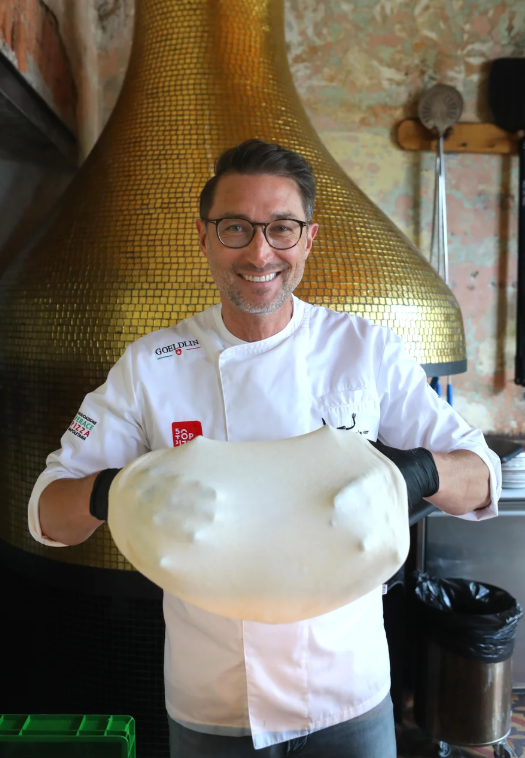
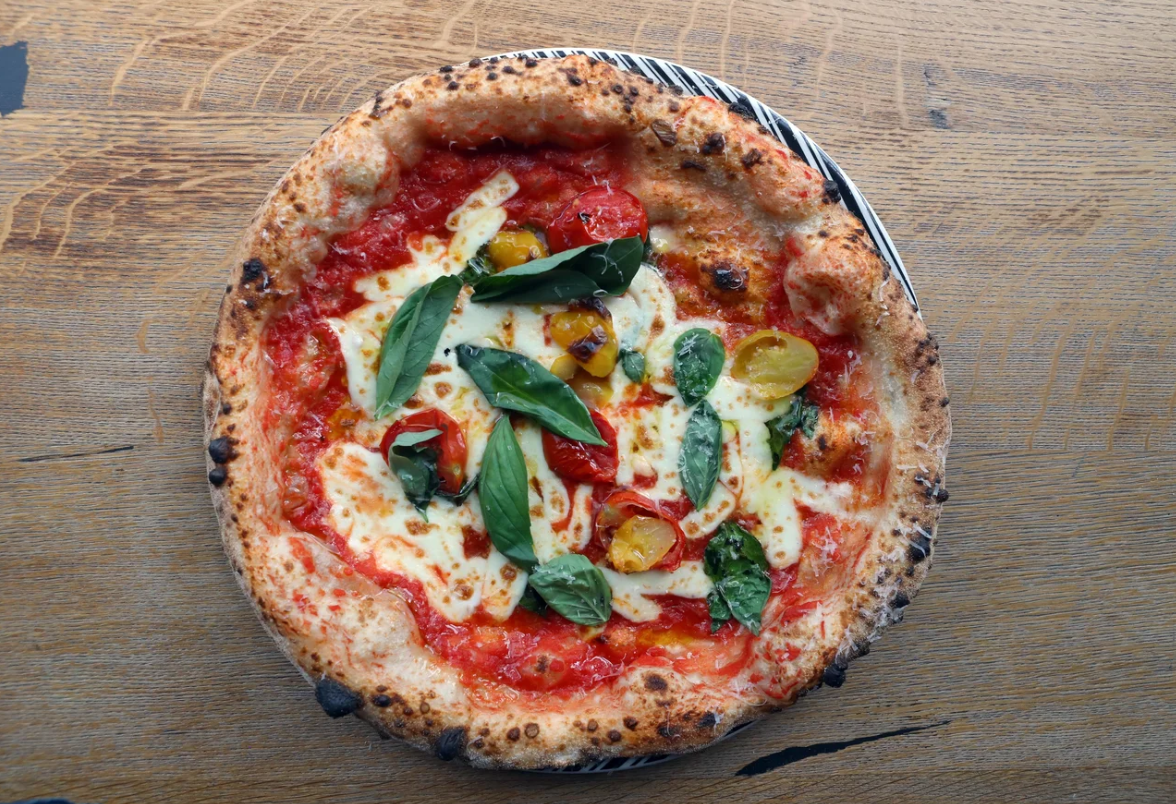
What, then, is the pizza that Yurkovich mastered through his stubborn study, such that international experts took notice? “We mix the dough with a starter I cultivated myself, based on wine yeasts. My uncle, you see, is the Croatian winemaker Vlado Krauthaker. We buy the flour in Italy, because for a repeatable result I have to have flour in which the protein content — that is, the strength of the flour — has been measured with extreme precision. Every day we bake six to seven hundred pizzas, and the process has to be controlled and predictable; there is no room here for interpretations on the fly or improvisation. In a day we use around eighty kilograms of flour, which a specialised machine mixes with the starter and water, and on which we can precisely control the temperature required to start fermentation. That then lasts thirty-six hours. This part, the dough, is actually the most interesting thing for me as a pizzaiolo, and the greatest challenge. Then of course there are the ingredients, which we also seek out around Italy. I would have nothing against them being Slovenian, but as I say, we would get stuck already at the flour, and at the mozzarella… Now you have reminded me: some time ago I travelled through the Italian region of Matera. When I came back, I got the inspiration for a pizza with the flavours characteristic of that place, or rather with the ingredients that are especially good there. The Pizza di Materina came out of it. Two and a half million views in a few days on social media.” (laughs)
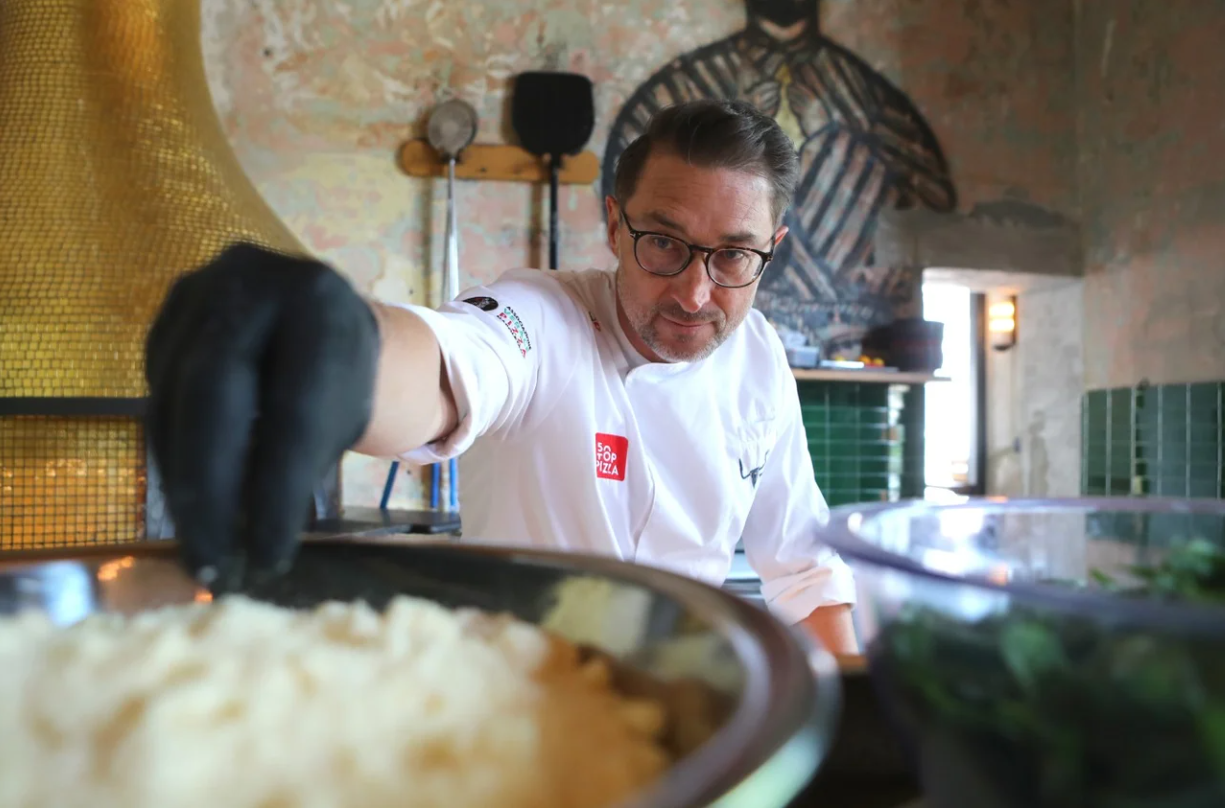
This stubborn returning to the source of knowledge — for the courses, ever more specialised, simply continued — and those two hundred pizzas a day actually tell another story about Yurkovich. He has no swollen ego: because to take hold of a completely new business, to join twenty-year-olds who are also only just learning it, and to bear the initial defeats — that is no small thing. Here his sporting spirit probably shows a little. In hisyounger years, when he still lived in California, he was a rower, and quite a good one: it even earned him a scholarship to the distinguished University of California, Los Angeles, where he studied political science and Russian before turning, professionally, to finance. Nor are those two hundred pizzas a day nothing. A computer scientist, a mathematician or a business analyst would recognise iteration in it: continual improvement through numerous repetitions, in small steps with small new variables, on the basis of an always identical equation. Yurkovich admits that even after entering the world of food he has not shaken off certain methods from his “previous” life: “As a financier I learned a great deal about why some companies are successful and others are not, and I keep trying to direct that knowledge into our projects. So, for instance, we decided that we would be focused: why offer all manner of things when it is clear that the guest came for a burger. And the guest knows why he is here: he wants high quality, an experience, something that did not exist in this form before. That kind of offering, it seemed to me, was missing in Slovenia. Pizza too: it simply was not valued enough. And I wanted people to feel my desire to keep raising the level all the time. I want them to come into our place, for a burger or a pizza or an aperitivo, and get more than they expected, for fair money.” And there is one more thing Yurkovich says he brought from his previous career: a way of managing staff. As he puts it, he is repelled by the figures of the gazda — the swaggering patriarch-boss — a type that is dying out here as well, though we all recognise them, because of our geographical position and the old days. “Sebastijan and I present ourselves modestly. We do not parade like puffed-up men in front of people who work hard. Because that is the reality in our trade — graft. Am I now to appear among them decked out in Louis Vuitton, with a Patek Philippe watch? I would rather not wear a watch at all. Instead of showing off, I pick up a scrap of paper if I see one on the restaurant floor. I am not friends with my employees, but neither am I a gazda: I praise instead of shouting, and above all I am polite,” says my interlocutor.

The move to Slovenia, which was supposed to be temporary, has thus simply stayed put. It was made a little easier by the fact that his wife, who is American, also managed to continue her singing career here. But what seems to have weighed still more decisively is that the husband — himself an interesting mixture of Slovenian and Croatian roots — turned out, as it emerged, to be surprisingly far more a man of Naples than of Disneyland. “We lived in Orange County, which is exactly between Los Angeles and San Diego, in the city of Newport. Beautiful beaches, beautiful mountains, beautiful deserts — but no depth. All that orderliness became for me a little, I would say, perverse. There are no emotions left in it, everything is Disneyland: colourful and lovely to look at, and then you look up close andit is all plasterboard. Nothing but facsimiles. A hundred identical houses in a row, or a whole development that looks like Positano. But it is not Positano. Here in Ljubljana I go to the market, I buy from the fishmongers, they know me. I walk a few steps further, to an old woman with dirty fingernails whose vegetables I adore. Or I drive to Trieste for a coffee. You don’t get that in California. What you do get is the pressure that you must always have a bit more, and then a bit more, and then more than more. In the end you become apathetic and nothing means anything any more.”
